Tuesday, April 20, 2010

Reader's Advisory - You'll never guess what I did!!


April 16th and 17th found me at an Indiana Genealogical Society two-day seminar in Fort Wayne. Actually, the seminar was only one day, but there was a workshop on Friday for members of genealogical societies. FYI – librarians earn CEUs on both days. This year, the Friday workshop focus was preservation at the various levels – genealogical society, local (county) and state. And because I have a large interest in archiving, I just had to attend. Saturday offered various topics of interest to we who refer to ourselves as genealogists.

Anyway, because of the Friday seminar, Allen County Public Library remained opened for a late night genealogy research opportunity. I attended the late night with a friend of mine because I needed access to WIFI and my cheapy motel did not offer it (but what can you expect for $30/night?). Anyway, as I was working on an assignment for my other class, I noticed an older gentleman (in his 70s or so) reading a paperback called The Texan. I kept thinking about the body of work we have for this class, but also what I have taken upon myself to read on my own. You see, I have somehow read three Elmer Kelton westerns from his Texas Ranger series during this semester. And I have to admit that they are pretty darn good. So I got up from my seat and walked over to the gentleman and his wife. I introduced myself and stated I had noticed his book. I then proceeded to ask if he had read any of Kelton’s books. He had never heard of him. Bingo!!! Although unsolicited, I performed an act of Reader’s Advisory. One that I never thought I would do, but I bet neither did any of you! I wrote the author’s name on a slip of paper and handed it to the gentleman and he seemed appreciative. We talked for a little while and then I went on about my business.

Why did I do this? You know, I’m not really sure why. I didn’t know this man at all. But something inside me said to do this little act of kindness. Accidentally, I found Elmer Kelton and enjoyed his books. They are good westerns. I feel as though I am right there. Of course, having a passion for American history helps. But Kelton’s westerns aren’t sappy with romance like a good amount of historical fiction. Love is in the air with Kelton, but it is more reasonable, more down to earth, more pleasing (at least for me). Is the lack of sappy romance because the author is a man? I don’t know, but I get more landscape, more realism, less fantasy than historical fiction.

Anyway, I am proud of my unsolicited Reader’s Advisory advice performance and hope you are as well. I just had to tell someone. Well, I have to get back to my reading now. An archivist advised me to read as much history as possible since I don’t have a college history background. Sounds like a good excuse for me to continue hanging out in the non-fiction area.


Saturday, April 3, 2010

The loss of libraries and access


As we all can attest, not having a library is very devastating. Here in Indiana, there are a number of communities where one cannot be found. But what about our state libraries? Are they any safer? The answer is no. In listening to The Genealogy Guys Podcast (yes, I said podcast), of March 26th (http://genealogyguys.com/index.php?post_id=598721), I have learned some disquieting news from around the country.

If you take a look at the State of Michigan website (www.michigan.gov) you will see that there is no longer a Department of History, Arts, and Libraries. The Board of Trustees of the library and the Michigan Library itself now fall under the Department of Education. The position of State Librarian has been abolished. You can access and read the Executive Order by going to the state website, type 'Library of Michigan' in the search area, and then click on Michigan Department of History, Arts, and Libraries. You will see the link to the Order under "Michigan says farewell to the Department of History, Arts, and Libraries". For now, the collection will stay where it is, but there will be some losses of jobs and other things. And that is only the beginning.

In New Jersey, there is a possibility that the New Jersey State Library and the Thomas Edison State College will be merged under the New Jersey State Museum governed by Rutgers University beginning July 1, 2010. The Charlotte-Mecklenburg County (NC) Library system announced a closure of 13 branches. That is an awful lot of libraries in an awful lot of communities. Because of the community outcry, these branches will not be closed, but the hours will be cut as well as jobs. In Florida, the legislature is considering the elimination of more that $22 million in aid to libraries. And then in Massachusetts (this isn't about libraries but access to records) there is a senate bill recommending the closure of access to all vital records after 1841.

That is a lot to take in. And what makes it worse is that I know I am a part of the funding problem. Why? Well, I have not replaced the job I lost more than a year ago. I am working a temporary part-time job right now, but I am not paying the taxes I had been paying and I am not purchasing much of anything. And I am only one. I know it is not my fault, but it is still very difficult to read about these things. It is times like this that I wish I had millions to spend.

But what is also just as frustrating is that the government keeps telling us to volunteer. Now, I don't mind volunteering. FYI - I have been a volunteer at the Indiana State Library for a year now and truly enjoy it. But I can't make a living on volunteering. And if libraries need a lot of volunteers, what is that saying? There are a few of us SLIS students who are current volunteers in the Library Development Office of the State Library. We 'work' for a woman who is the Digital Initiatives Librarian for the entire state. Do you know the size of her staff? One. Just one person overseeing the entire state. Connie has more projects on her plate than the White House has eating utensils (and we all know how many people are invited to all those dinners). She travels the state and trains librarians on digitizing as well. I can't even do justice to all the things she has going on. I have yet to see her take a lunch break and from what I am told, she is the first one there (in that office) and the last one out the door. When I saw her Thursday, I learned she would most likely be working this weekend - a three day weekend for the state employees. And they haven't had a raise in three years!

What are we coming to? What does this say about our society? And where are we going? As Barbara Tuchman once said "Nothing sickens me more than the closed door of a library." Though nothing has happened yet with our own state library, there have been times when the hours were reduced to Monday-Friday, 8:00 - 4:30. And what makes things worse is that because it is a state library, foundations are not allowed. Yet, it is to offer services to the entire state, to every single one of us if we so choose.

Lady Bird Johnson once said, "Perhaps no place in any community is so totally democratic as the town library. The only entrance requirement is interest." But one of my favorite quotes is from John Bright 11/16/1811 - 3/27/1889, a British orator, Quaker, and statesman. Now before you read this, PLEASE understand that, 1) Bright was a product of his time, and 2) when he says 'men', I include women. So if you do those two things, you might like this quote: "What is a great love of books? It is something like a personal introduction to the great and good men of all past times. Books, it is true, are silent as you see them on the shelves; but, silent as they are, when I enter a library I feel as if almost the dead were present, and I know if I put questions to these books they will answer me with all the faithfulness and fullness which has been left in them by the great men who have left the books with us."

Well, I have rambled long enough about the sad news in the podcast. I suppose the question to be answered is if a library near any of us was proposed for closure, what would we be willing to do to stop it? To what lengths are we willing to travel and who we will take with us? And even if it isn't proposed for closure, what are we willing to do to make it the best? The funny thing about my volunteer experience is that I have been turned away by two libraries that keep saying they need volunteers. That is how I landed at the state library. But perhaps I need to go back and see if I can't convince them that they need me. Lord knows I haven't been able to land a library job, and trust me when I say I am better off in an Indiana Room, the state library, or the archives. Or should I say the patrons would be better off if I am in one of those places. Anyway, just food for thought.

Sunday, March 28, 2010

The Attack of 1918

Out of all the reading that has been assigned, now is my opportunity to shine. Right? It is nonfiction and that is my favorite area. But I have been subdued by my choice, something I did not expect. I have been touched by this selection and if that wasn't enough, I read a second nonfiction book. That will be a separate blog.

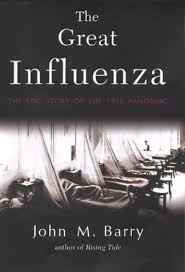
Okay, so back to this entry. This book came into my life before I began this class. The Monday night of the first week of class, I parked myself in front of the TV at 9:00 pm to watch one of my favorite shows - "American Experience" on PBS. That night's episode was about the influenza epidemic of 1918. It was so well made I wanted to know more. So the next day, I went to the local library and found The Great Influenza by John M. Barry.


If you don't know anything about this time in our country's history, then you should read this book. If you do know, you should still read this book. Yes, it's thick - 546 pages. But if you subtract the 40 pages of notes, the 21-page bibliography, and an index of 18 pages, that makes it a little smaller. I cannot say how long it took me to read because 1) I'm a slow reader, 2) I had to reread some medical and scientific passages, and 3) there was fiction to be read. But I did manage to get back to it. I had to. It is compelling.

We start 30-35 years before the outbreak by taking a look at the medical training in America and Europe. Let's just say America is a little bit behind. To attend medical school, you don't need a college degree. You can fail a class numerous times and still earn your certificate. There are no hospital rounds, no live patients, no internships, no research, no lab work, no microscopes. Some training, don't you think? Europe required so much more. It was time for change. William Welch desired that through his efforts and a few friends, he was able to change the face of American medical schools. His efforts have given us John Hopkins Medical School and a new way of teaching the practice of medicine.

Then WWI broke out and we stayed out until April 1917. Men are drafted and sent to military camps, then sent overseas. All is well - for a while. Winter came and the so did the influenza, but it's the typical case. Some children die and some elders, but nothing that should worry anyone. The year goes by and there is talk that the war may be winding down. But we are still drafting, still training, still cramped. Parades, gatherings, shopping - all activity as usual - all feeding grounds for the flu. And then someone passes out on the street before your very eyes and is dead by nightfall.

While Barry's research is more than just thorough, it is the style that keeps calling, beckoning you. As in all historical nonfiction, the end is known. But it is how you get there that counts. A reviewer on Amazon stated that Barry includes unnecessary information, such as insight into the scientists' lives. I disagree. An epidemic affects people in many ways and it is this that Barry wants to show - at least that is my opinion. Scientists have given their lives to research - day in, day out - so we have a better life. Although they did not invent a vaccine then, their research has led to many other findings.

The pacing ebbed and flowed just like the flu epidemic. For a large part of the book, the pace kept moving rapidly accompanied with the writing style of panic and fear. I could feel every emotion, every pain, angst, fear. I was there on the streets, in the camps and hospitals, on the trains, in the labs. He plants the reader in the middle of it all. The characters? Ever heard the song "Getting to Know You" by Oscar Hammerstein from The King and I? Did I ever get to know them! It is almost like reading a biography at times. I became friends with a few of the scientists and doctors. And I learned so much about the flu, the main character, not only what it did in 1918, but how it has changed over and over. It is something that is still being studied today.

Anyone who loves American history should read this book. It reads like a horror book, a mystery, a biography, and a history book, all wrapped into one. It is good for those who want to learn what life was like for their ancestors, for those interested in science and medicine. The technical terms may make you look things up on the internet, and you may need to reread some passages, but it is well worth the time and effort. Just ask someone whose family member died from it. I have - two of them. Fascinating stuff. By the way, I am looking forward to reading another John M. Barry book very soon - Rising Tide: The Great Mississippi Flood of 1927 and How It Changed America.

For read alikes, I went with related reads and fiction books on this topic (teens and adults). Teens may not want to read a 546 page nonfiction book, but they may need to learn about the epidemic.

Related reads (Reader's Advisory): Polio: An American Story (David Oshinsky); The Great Mortality: An Intimate History (John Kelly); Plague and Fire: Battling Black Death and the 1900 Burning of Honolulu's Chinatown (James Mohr).

Fiction reads on this topic: Adults: Kathy (Linda Sole-Adult); The Last Town on Earth: a novel (Thomas Mullen); This Time of Dying (Reina James); The Paradox Syndrome (Ken Hodgson).
Teens: Winnie’s War (Jenny Moss); The Influenza Pandemic of 1918 (Claire O’Neal; Blessings Bead (Debby Dahl Edwardson); The Goodbye Season (Marian Hale); The Flu Epidemic (JoAnn A. Grote); Fever Season (Eric Ziveig); Marvin of the Great North Woods; Kathryn Lasky.

Friday, March 26, 2010

A Mystery Recommendation from My Mother


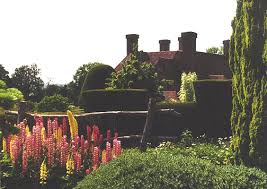
Well, normally I post the book cover, but I can't do that and Google can't show me a photo of the author so you will have to deal with a photo of where Dorothy Simpson resides, Kent, England. But it's a lovely picture.

Anyway, my mother has just finished reading Dead by Morning and loves it. Although it is a murder mystery, the plot unfolds the unspoken truth behind the marriage between Mona and Desmond. Mom enjoys the twists and turns of Ms. Simpson's books and highly recommends them.

So, in case you aren't acquainted with this author and need a mystery, just know that her books come highly recommended by my mother, an authority on mystery books that aren't too graphic, don't involve detailed sex, but is an all around good read.

Every once in a while my mom is good for something (just kidding!).

Tuesday, March 23, 2010

Bonanza (in more ways than one)


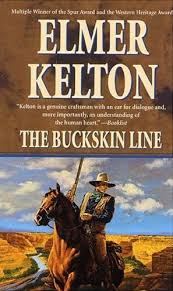
The Buckskin Line
by Elmer Kelton


If you read my Secret Shopper post, you know I ended up checking out an Elmer Kelton western, The Buckskin Line, which is the first book in his Texas Ranger series. Well, I finished it a few days ago. I have already read a western for this class and have blogged about it, but I just had to let you know how it went.

First of all, it doesn't fit all of the characteristics of a western as described in our text. It takes place beginning 1840 and ends in 1863. But it's the Texas Rangers and they're fighting Indians. There are ranches and cattle and farms - danger all around in the beautiful Texas country. Rusty is kind of a loner, but not one who is riding around, rights the wrong, and then leaves for another place. He is a loner but not by choice and he leaves his home to do perform the duty he was sworn to do. Just like his 'father'. And he wants to go back home. But I still think it's a western.

Kelton's story begins with the story with the Comanche Indians on a raid, killing the parents of a toddler. The boy is taken by one of the Indians to be his son only to lose him when the Texas Rangers find them. One of the Rangers and his wife 'adopt' the boy, whom they nicknamed Rusty (for his read hair). We then advance twenty some years and find Rusty a grown man living at home. His 'mom' dies of natural causes, but his father is murdered. Although wanting revenge, Rusty is called by the Texas Rangers for service and Texas votes to leave the Union. Now that most of the men have gone to war, the few remaining Texas Rangers, including Rusty, have to keep the Indians in line. But Rusty can't let go the revenge he wants for Mike.

Did I like it? Well, let's just say that I am waiting on the 2nd book in the series to be returned to the library. At least in this book, I didn't have to read about how Rusty and the daughter of a family he meets can't do without each other or get all sappy. I am hoping to pass this writer onto my grandson in a couple years. I think he might enjoy the books. It's well written, keeps you attached to it. Well paced. Nothing gruesome, no killing details. You're told the scalps were taken, but you can use your imagination. Kelton, who just passed away last year, does not use a lot of western jargon or lingo, at least not in this book.

Yes, it's head 'em up, move 'em out for me for a while anyway. Just as long as I don't stop reading nonfiction. I have to get my fix from time to time.

Wednesday, March 10, 2010

My Father Loved Zane Grey


TO THE LAST MAN

by Zane Grey


When I was growing up, my mother worked nights and so my dad was responsible for the four of us kids. We grew up on westerns. Yes, my dad loved westerns. John Wayne, Jeff Chandler, Jimmy Stewart, Clint Eastwood. Bonanza, Gunsmoke, Palatin, you name it, we watched it. And that was okay because we all survived them. They weren't my mom's choice on the nights she didn't work, but it was my father's house so westerns ruled the roost.

But the one thing I remember most is the set of books that sat on a bookcase in the family
room - a Zane Grey series. My dad loved Zane Grey so much so that he was nicknamed Zane in high school. My mother bought those for my dad. There were lots of times I thought about picking one out and reading it, but they were my dad's books. I never asked if I could read one of them.

So what have I chosen to read for the landscape genre? You guessed it - a Zane Grey book. There aren't that many of Grey's books to select from at my local library and the ones they have are not in the best of conditions. I don't know if that is because they have been around so long or if they have been read a great deal or a little of both.

To the Last Man, written in 1921, is a novel based on a true story - the Pleasant Valley War. In this version, Gaston Isbel summons his son Jean in Oregon to come to Arizona and help with the cattle and horse ranch. The sheep herders have moved into Grass Valley and bad times lie ahead. Isbel needs his son now and tells him to bring guns and lots of ammunition. Jean is also warned to only listen and not talk when he arrives. Cattle are missing, which always happens, but not to this extent. Cattlemen and sheepmen don't mix. Not until Jean arrives in the valley does he learn the whole story - that the enemy is a long time foe from Gaston's earlier years in Texas, that this fight has been brewing for years. The trouble began during the Civil War. After Gaston left to fight, Lee Jorth moved in on Gaston's girl, marrying her before the soldier returned home. Gaston proved Jorth was a cattle rustler and ruined him. Now Jorth has come to make him pay. But how will Jean handle the situation now that he has fallen in love with Jorth's daughter?

There is no doubt that Zane Grey, for the most part, falls into the Western genre. First, the location is in the American west. For this book, it occurs in Arizona. Contrary to what our text states, the reader knows exactly where the story occurs. Grey reveals this information in the Foreword as well as throughout the story. It does, however, take place about twenty-five years after the War Between the States. Our hero is a loner for several years since his family moved to Arizona, living in the forests and fishing in the waters of Oregon. Not tied to anyone. He has well developed hunting and tracking capabilities, but when it comes to disagreements with other men, his guns are the last thing he uses. But it does come down to survival of the fittest in the end. Grey's storyline strategy is a developing one, where the reader may believe the plot is unknown when in fact it is just a cover for the real issue at hand. It is a story of revenge and the law is nowhere in sight. But how do you create laws to deal with jealousy?

It was a book I found difficulty in putting down and for several reasons. I wanted to know more about this man named Jean (reminded me of Johnny Cash's song), this half-breed as some would call him. Though I knew how the story would end and that the hero would get the girl, I wanted to know how it played out. And then there was Ellen Jorth, the only daughter and child of a man she never knew or understood. The only woman among a gang of thieves and killers who pawed at her and claimed her for their own, whether she was or not. She was fighting for her freedom as well - trying to find her own identity. The pacing began steadily and, just like anyone headed for trouble, it sped up more and more until the final shoot out. Yep, it was action packed! And it was just like sitting in front of the television watching the Matt Dillon try to talk the bad guy into laying down his gun before something bad happened. Reading some of the dialogue took a little getting used to. It reminded me of Festus, the old western slang and lingo.

Yes, it was a struggle of good vs. evil, with the good not always being good. But there was the internal struggle that both Jean and Ellen fought within themselves. The struggle to do what was right and forgetting that 'right' had nothing to do with family names. The struggle to put the past behind and move on. The struggle to just laying down the gun and walk away.

By the way, I picked up another western during my secret shopper investigation. It's not another Zane Grey though. This one is by Elmer Kelton, a more contemporary western genre writer who passed away just last year. It doesn't fit the usual western in that it begins in 1840 and ends in 1863. It takes place in Texas and is more of a cowboy-Indian story. So far, there hasn't been any romance (which doesn't bother me), but about the Comanches trying to take back their land. So far, so good. It is the first book in Kelton's Texas Ranger series. Perhaps I am my father's daughter after all.


Read Alikes - Authors (Fantastic Fiction): Zane's sons - Romer Zane Grey and Loren Zane Grey; Elmer Kelton; Louis L'Amour; Max Brand (outside of the Dr. Kildare series); Ralph Compton; William W. Johnstone; J. T. Edson; Ralph Cotton; Lewis B. Patten; Terry C. Johnston; Alan LeMay (Indianapolis native); Fred Grove.

Read Alikes - Books (NoveList): Dreams to Dust: a Tale of the Oklahoma Land Rush by Sheldon Russell; Last Child by Michael Spooner; Redeye: a Western by Clyde Edgerton; Not Between Brothers by D. Marion Wilkinson.

Tuesday, March 9, 2010

Playing I Spy


The day had finally come for me to spy on a local librarian. I knew the importance of this assignment, but ratting out a librarian? I didn't want to do that! I had already experienced librarians who couldn't help me find nonfiction readings. I had already heard some bad stories from others about their experiences. Oh, I didn't want to do this. But I did, like a good little student.

So I went out of town - not far - just up the road from my house. It wasn't one I have visited before. Well not for library services. I attended a program them several years ago so I was comfortable that no one knew me. It took me a couple minutes to figure out who I should ask. The circulation desk was right in front of me upon entering the library, and there were three librarians behind the desk. I don't think I could have looked any more like I didn't know where I wanted to go. There was one customer at the desk and even after that person left, no one asked me if I needed any help. Hmmm, wasn't going very well so far. Was this a warning sign?

I finally got my bearings - finally figured out that the adult side was to my right. On my way, I noticed the reference desk and that it was staffed by one librarian who was busy helping a patron on the phone. So I walked around until he hung up. He began walking away when he noticed me approaching the desk. He looked right at me and then asked if he could help me with anything. I conveyed that a friend said I needed to step out of the nonfiction world, that I needed to read the 'real' stuff. He chuckled, introduced himself, and shook my hand. "Well", he said, "Do you want to dip your big toe in the water or dive in?" "Good question", I replied. "I don't know yet."

At this point, Bill asked me what I like to read. So I told him I am a real David McCullough, John M. Barry, and Shelby Foote fan; that I like American history, but that I don't normally read anything after WWII. Bill's first recommendation was historical fiction. I told him perhaps, but I didn't want anything overly wrought with sex or 'I can't do without you' verbage. It tends to nauseate me. He looked in the library's catalogue and did a search under 'historical fiction'. He also looked in NoveList and Dear Reader. Finally, Bill admitted that he did not know most of the authors, but we went over the lists and we finally settled on Laura Kinsale. So we walked over to the shelves and we found two books by this author. He sensed my hesitation and because he saw another patron at the desk, Bill told me to look around and be sure to come back to the desk if I had more questions or needed more assistance. I kept looking around on those shelves and noticed a western by Elmer Kelton. So I pulled it out, leafed through it and saw that it was the 7th book in Kelton's Texas Ranger series. Starting in the middle of a series is like watching a sequel of a movie before seeing the first one. I can't stand it. Because I couldn't find a list in the book of the others in the series, I returned to Bill and asked him if he could determine the first book in the series. So he researched the internet and found the list. Then he looked it up in the library's catalogue and saw that it was available. So we walked to the shelves to get it, but it was in a different area than where I located the other one. This time, we were in the Western genre shelves. I mentioned this to Bill. So we went back to where I found the other books - in the general fiction. We found three other Kelton books - all part of the Texas Ranger series - in the general fiction and not in the western genre. We were both a little confused. So I took the western, The Buckskin Line. By this time, there was another patron waiting at the counter so Bill went left to help her. As I began to leave, Bill told me that he hoped I would enjoy my big toe dip in the water, to let him know if I enjoy it and that he would look into the cataloging as general fiction.

All in all, I was pretty happy with the experience. Bill was very friendly, helpful, resourceful, and yet cognizant of other patrons in the area. It would have been better if he had some idea of the authors as I didn't recognize them. I knew he would recommend historical fiction - the dip similar to the dip I took in selecting Poyer's book. But he made me feel important and went to some length to find me a book. I will read it; I went to the trouble of checking it out so why not? I will just have to fit it in with all my other reading.